

Higher education is facing a retention crisis, and academic pressure is often the silent driver. While institutions have historically relied on reactive counseling services, the reality is that most university students reach a breaking point long before they seek support.
For leaders in colleges and universities, the challenge is no longer just about providing resources; it is about visibility. As discussed in our analysis of continuing education in top universities, the stakes for maintaining student engagement have never been higher.
How do you identify a student who is drowning in coursework, anxiety, and depression before they drop out? The answer lies in the data you already collect. By shifting from reactive care to predictive monitoring, institutions of higher education can use attendance patterns to respond when it matters most.

Academic rigor is essential, but the current environment has tipped the scale. To build effective strategies, administrators must first understand the operational impact of academic stress on the school itself.
There is a direct correlation between high-stress periods specifically around November, December, and January exams and spikes in dropout rates. However, student stress rarely manifests as a sudden resignation. It is a slow burn.
Undergraduate students overwhelmed by demand often disengage gradually. They miss one lecture, then a deadline. If your retention strategy relies solely on mid-semester grades, you are seeing the data too late. Our research on the impact of attendance tracking on learner retention confirms that the decision to leave typically happens weeks before the official paperwork is filed.
The modern student faces a “perfect storm.” It isn’t just about hard classes or the science curriculum; it is the compounding weight of financial uncertainty and the social isolation inherent in modern virtual learning models.
The shift to hybrid environments has created flexibility but also distance. Without the natural interactions of a physical classroom, students can feel invisible. To combat this, faculty and staff must recognize that academic performance cannot be decoupled from health and wellbeing. A student dealing with mental health challenges lacks the cognitive bandwidth to perform academically.
Recent studies found on Google Scholar and PubMed highlight that mental disorders are a critical factor in career derailment. To mitigate academic pressure, we must look at the whole picture.
Universities are data-rich but often insight-poor. You have thousands of data points on student behavior. The goal is to synthesize this information to flag “at-risk” status objectively.
Absenteeism is the single most reliable proxy for student wellbeing. A student who stops showing up is rarely just “lazy”; they are often signaling a psychological issue.
In a physical or hybrid campus, tracking this data manually is inefficient. Digital solutions allow you to spot these trends instantly. If a student enrolled in a life science or degree program suddenly misses three consecutive classes, this is an immediate red flag. It warrants a check-in to navigate the issue before it leads to failure. This is precisely why every university needs a class attendance app in 2026 to make these invisible signals visible.
Faculty of education members often rely on intuition, but this doesn’t scale across a national university system. Predictive analytics involves combining distinct data sets. In fact, the data from your student app is a goldmine for understanding these behaviors:
When these metrics drop, the system should trigger an alert. This allows support teams to reach out with specific accommodations before the student fails a course.
Budget constraints mean you cannot hire an infinite number of counselors. Technology must bridge the gap to deliver mental health care at scale.
You do not need to overhaul your entire IT infrastructure. The key is interoperability. Your attendance software must talk to your LMS and CRM.
For example, connecting your attendance data directly to Microsoft Teams or Salesforce allows academic advisors to see a dashboard of “at-risk” students every morning. This requires robust tools; knowing the top 10 essential features in a student app can help you choose the right ecosystem.
Technical Note: Managing this data requires strict compliance. We understand the challenges of managing learners’ personal data in the era of big data. That’s why Edusign seamlessly integrates via our dedicated integration page, supporting connections with over 1,000 tools including Zapier, Make, and major ERPs like Aurion.
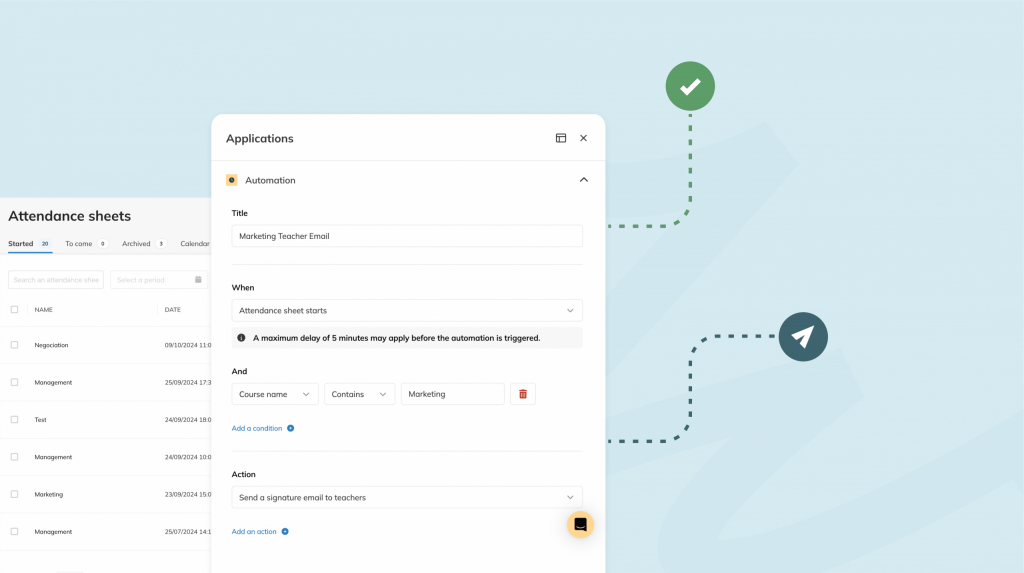
An effective EWS removes the manual burden. Instead of relying on a lecturer to notice a student is missing, automate the process:
This automation creates a supportive environment where no student falls through the cracks.
Data tells you who needs help; strategy dictates how you help them. Implementing these strategies requires buy-in from both administration and staff.
Administrative friction adds unnecessary pressure to students who are already struggling. Complex processes for justifying absences can be the straw that breaks the camel’s back.
Digitizing these workflows via a dedicated student application allowing students to upload medical certificates via an app reduces anxiety. It fosters a climate where students feel safe asking for flexibility.
Furthermore, moving from theory to practice in your curriculum design can make learning more concrete and less abstractly stressful.
Not every student needs a clinical psychologist. Many benefit from coping mechanisms and stress coping workshops.
Institutions can offer workshops on:
By tracking participation in these programs, you can measure which coping strategies effectively reduce student stress.
Note on Research: Whether you are reading a paper with a Creative Commons attribution license or a review in a specific DOI-referenced journal, the consensus is clear: non-specialist interventions, like peer support groups or school for social initiatives, are highly effective when discussed openly.
The landscape of higher education is becoming increasingly competitive. Colleges and universities that fail to promote a positivelearning environment will see their retention rates suffer.
We are moving toward a model where AI can suggest personalized academic paths based on a student’sexperience and stress markers. Embracing concepts like adaptive learning allows institutions to tailor the pace of education to the individual, further reducing mass-standardized stress.
Tools like Edusign are evolving to provide deeper insights into cohort behavior, helping leaders understand not just individual struggles, but systemic issues within specific courses.
